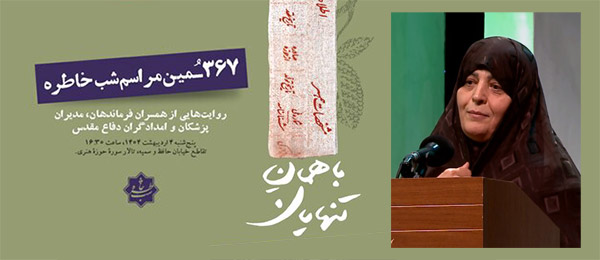
The 367th "Night of Memory"
Edited by Iranian Oral History Website
Translated by Mandana Karimi
2025-5-8
The 367th "Night of Memory" program was held on Ordibehesht 4, 1404 (April 23, 2025), coinciding with the anniversary of the martyrdom of Imam Ja'far al-Sadiq (PBUH), at the Andisheh Hall of the Arts Center of the Islamic Revolution. The event featured stories shared by several wives of medical corps veterans from the Holy Defense. The speakers included Mrs. Masoumeh Khatib, Ashraf Fard, Zahra Mazloumifar, Fatemeh Amrollahzadeh, and Fatemeh Habibi.
Also during the ceremony, with the presence of Major General Seyyed Yahya Rahim Safavi—senior advisor and special aide to the Supreme Commander-in-Chief— the book “With the Lonely Ones” by Maryam Nezam-Doust was unveiled. The program was hosted by Davood Salehi.
The first speaker was Mrs. Masoumeh Khatib, the wife of the late Abdolhossein Pourbashash. She began by honouring the memory of her husband and said: “He always used to say, ‘I have made a deal with God in this war.’” Recalling the days she accompanied him in hospitals where chemical weapon victims were being treated, she added: “At some point, I could no longer continue that deal with God. I told my husband, ‘I will take care of everything at home; you fulfil your mission.’ I still regret that I couldn’t be as good a dealer with God as he was.”
“My husband was a commander who held no official rank of general, but he was a general in people’s hearts.”
She continued:
“My husband was at the front just a few months after our marriage. Sometimes, we had phone calls just to check in on each other. Then Operation Badr began, and during that operation, he was exposed to chemical weapons. He didn’t want to upset me, so whenever I called, he wouldn’t answer. In the days that followed, when I tried again, a man told me that my husband was attending to the wounded and couldn’t come to the phone.
As his condition worsened, he was transferred to Tehran. After some time, when he got a bit better and was discharged from the hospital, he returned to Shiraz. Still, he didn’t tell us anything about his injury or exposure to chemicals. He showed symptoms like coughing and chills, and eventually, the doctors concluded that he had developed leukemia. Only my mother knew about his illness, and since she regularly attended mosque and prayer gatherings, she shared it there and asked people to pray for his recovery.”
The speaker continued:
“We had the chance to travel to Mashhad, and while we were there, my husband’s illness worsened. He developed a high fever and a severe cough and had to see a doctor. But since he knew the doctor might say something that would upset me, he didn’t allow me to go with him to the clinic. The doctor told him that the cancer had returned as a mass in his lungs and that he needed surgery in Tehran as soon as possible.
While my husband was at the doctor’s, the kids and I went to the shrine (of Imam Reza) and prayed for his healing. We also brought back some blessed water from the Saqqakhaneh (sacred water source) for him. When we went to Tehran for the surgery, after the examination and tests, the doctor said there was no trace of cancer or chemical injury in his body. He only had a mild infection, which could be treated with antibiotics.
This was a miracle that, thanks to Imam Reza (PBUH) and my mother’s prayers, was granted to our family—and my husband was healed.”
Number of Visits: 1092



The latest
Most visited
Challenges of Interviewing in Oral History
After years of studying the theoretical foundations of oral history, conducting numerous interviews and going through their post-interview stages, as well as reading the available body of oral history literature, I was eventually given the opportunity to evaluate the edited versions of dozens of oral history projects.Comparing the Narratives of Commanders and Ordinary Combatants in the Sacred Defense
An Analysis of Functions and ConsequencesThe experience of the Sacred Defense cannot be comprehended merely through statistics or official reports; what truly endures from war are the narratives of those who stood upon its frontlines. These narratives, however, vary significantly depending on one’s position, responsibilities, and lived experience.
Unveiling of the book "Oral History: What and Why"
The First report: Alireza KamariAccording to the Oral History website, the unveiling ceremony of the book "Oral History: What and Why" by Hamid Qazvini was held on Sunday evening, November 24, 1404, in the presence of experts in the field of oral history in the Salman Farsi Hall of the Arts Center.