Narrated by photos
An interview that was not done
Jafar Golshan Roughani
Translated by: Fazel Shirzad
2019-3-19
Yannis Behrakis, a well-known news photographer, who worked for Reuters News Agency, died on Saturday March 2, 2019.
He was born in Athens in 1960. He educated in Athens's School of Arts and Technology and received a Bachelor Degree from Middlesex University. In 1985-1986, he was a commercial studio photographer, and while he was working in there, he watched the film "Under Fire" and then he became eager to photograph war.
Then, he began to work with Reuters News Agency in 1987. In late 1988, she was offered a permanent job at the Reuters News Agency Branch in Athens; he accepted it. In January 1989, he have just joined Reuters for four days, and his first foreign mission was to Libya. Since then, as a photographer, he recorded and documented many events in the world. He photographed some events such as the developments in Eastern Europe and the Balkans, the war in Croatia and Bosnia and Kosovo, Chechnya, Sierra Leone, Somalia, Afghanistan, Lebanon, Iraq, Arab Spring in Egypt and Libya and Tunisia, the urban war in Ukraine, the ISIL bombing by NATO forces in Kobani Syria, the financial crisis of Greece and the refugee crisis in 2015 and made the world aware of hidden and obvious aspects. In addition, he covered Kashmir earthquakes, Turkey, Greece and Iran, and photographed four summery Olympics, the American World Cup 1994, and the years of Zionist conflict with Palestinians.
After traveling to Jerusalem[1] as head of the Reuters News agency team along with a group to capture Israeli-Palestinian conflicts in 2008 and 2009, he returned to his homeland in 2010 to cover the financial crisis over his country.
He once miraculously escaped from the Revolutionary United Front Revolt in Sierra Leone in 2000, while American correspondent Kurt Shork, a Spanish journalist, and Miguel Gil Moreno de Mora, a cameraman of Spanish Associated Press TV were killed in the This story. He spent his last years of his life with his daughter, Rebecca, and his son Dmitry and his wife Ellesouth. He suffered from chronic cancer; he died on March 2, 2019.
He hold individual and team fairs in Athens, Thessaloniki, London, Edinburgh, New York, Rome, Barcelona, Madrid, Portugal, France and Dubai, and received numerous awards during his activities. He received the European Fuji Award (Fuji Company) in 1998, 2002 and 2003 as European Photojournalist. He also won the Greek Fuji Prize seven times as a Greek photojournalist. His photography awards consist of Japan Photojournalism Day Award (2016), award from Reuters and Guardian Newspaper in 2015, Department of Publicity Awards from Missouri Journalist School in 2013 and 2015, the Best Prize for Best News Photography for Public News Narrations in 2012, The Annual Award of International Competition of Chinese Press in 2004, 2009, 2013, 2014, 2015 and 2016, the Botsis Prize of Greece was one of his photography awards in 2000. He won the First Prize in Public News Narrations because of his photography in Cousteau from World Press Photo Foundation in Amsterdam, Netherlands.
He came to Iran following the news of Imam Khomeini's death in 1989, and photographed the massive mourning of Iranian people, and left monumental photos.
Now, it should be noted why we did not recognize Behrakis as a photographer of that national mourning of photography in order to understand the significance of the photos of that event to talk with him and hear his memoirs as a person and non-Iranian photographer. Why and how did he come to Iran for this event? How long has he been in Iran? How many photo did he take and what ceremonies did he take photo during day when people said farewell to Imam Khomeini? How did he feel when he saw such an unbeatable funeral in the world? And dozens of other questions.
In the following, you will see two photos of the farewell ceremony of the Iranian people with Imam Khomeini and their funeral, recorded by Yannis Behrakis in June of 1990.
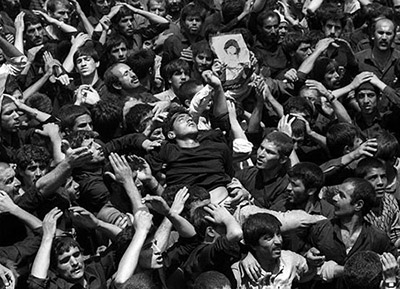
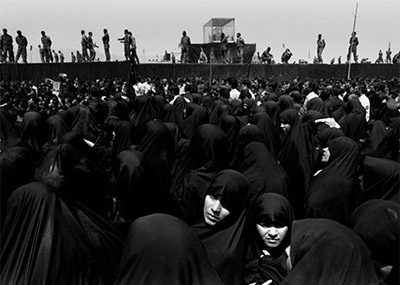
There are also three photos taken by the Greek photographer will be mentioned in the following.
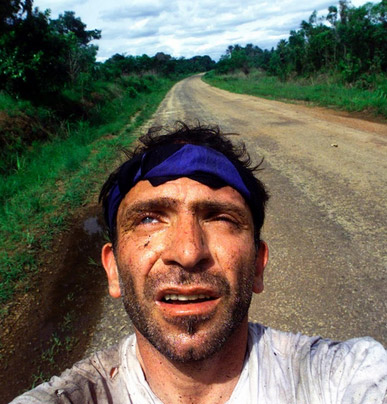
A Salfie photo that Behrakis took it while he was rescuing from an armed group ambush in Sierra Leone.
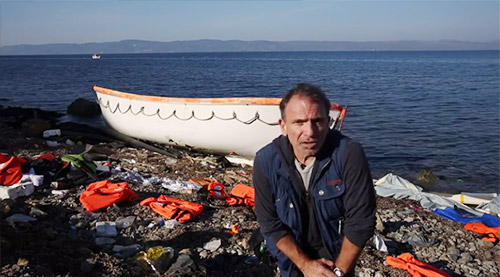
When Behrakis speaks about himself and photography, the video of this speech is available.
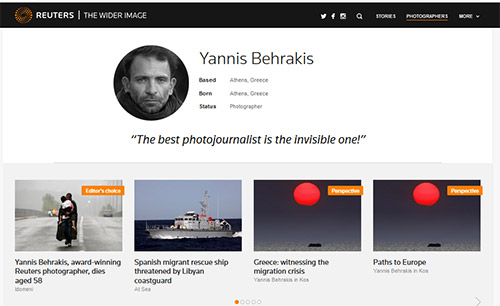
There is a sentence on the page of Yannis Behrakis's photos: "The best photographer is invisible one."
[1] Jerusalem is a city in the Middle East, located on a plateau in the Judaean Mountains between the Mediterranean and the Dead Sea. It is one of the oldest cities in the world, and is considered holy to the three major Abrahamic religions—Judaism, Christianity, and Islam.
Number of Visits: 9150



The latest
- The 373rd Night of Memories – Part 6
- Memories of Farshid Eskandari
- Authenticating Oral History: From Possibility to Necessity
- Third Regiment: Memoirs of an Iraqi Prisoner of War Doctor – 28
- An Interview with Members of an Iraqi Mawkib Present at the Gatherings in Tehran
- Memoirs of Manizheh Lashkari
- The 373rd Night of Memories – Part 5
- 100 Questions/27
Most visited
- 100 Questions/26
- The 373rd Night of Memories – Part 5
- 100 Questions/27
- Third Regiment: Memoirs of an Iraqi Prisoner of War Doctor – 27
- Memoirs of Manizheh Lashkari
- An Interview with Members of an Iraqi Mawkib Present at the Gatherings in Tehran
- Third Regiment: Memoirs of an Iraqi Prisoner of War Doctor – 28
- Memories of Farshid Eskandari
The Editor's Missing Place on the “Deck”
The book From Deck to Heaven offers a relatively fresh approach to examining the role of the Islamic Republic of Iran Army Navy (AJA) during the eight years of the Sacred Defense, published under the “Oral History of the Islamic Revolution” series. To compile this book, the esteemed author has utilized documentary research (referring to relevant archival centers and selecting documents) and field research ...An Exceptional Haft‑Seen Table
I wanted to celebrate the new year with my family. Together with two relief workers I boarded buses designated for transporting the wounded to Choubideh and received our mission orders. We waited for a helicopter to take us to Bandar Imam Khomeini. I was stationed near the helicopter’s touchdown zone and was slight in build. As the helicopter was about to land, I could not steady myself; the breeze generated by the rotor blades lifted me off the ground.Spring under the shadow of war
Composing the Spring special for the new year in the past years was mostly along with hope, nature’s rebirth and the promise of renewal of life. Spring has always been a reminder for returning of life and peace after the Winters’ cold. This year though, another atmosphere has settled over our land in the last days of Esfand (March).Excerpt from the Memoirs of Mohammad-Hadi Ardebilli
I registered for Konkour (university entrance exam), following the conclusion of high school. I was accepted into Tehran’s polytechnic (Amirkabir) university and began to study chemical and petrochemical engineering. There was a building named Jordan in the faculty in which religious students had prepared a small room as a house of prayer and did the noon and afternoon prayers in there.