
Report of the 15th Oral History Conference; Religion and Culture -1
The Formation of Independent Oral History Currents in QomMaryam Asadi Jafari
Machine translation edited by Mandana Karimi
2026-06-22
According to Iranian Oral History website, the 15th Iranian Oral History Conference on the topic of "Religion and Culture" was held on Thursday morning (June 11, 2026) with the participation of the Iranian Oral History Association, the National Library and Archives Organization of Iran, the Islamic Research Foundation of Astan Quds Razavi, and the Islamic Revolution Archives Center of Qom, at the Fadak Hotel in this city.
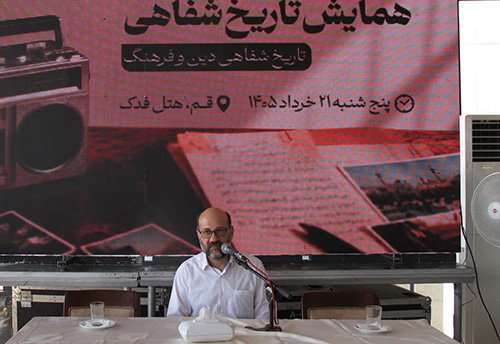
At the beginning of this ceremony, Dr. Ali Tatari, the Secretary of the Iranian Oral History Association, reviewed the process of holding the 15th Iranian Oral History Conference, from publishing the call to judging the articles and holding the preliminary sessions, and stated: "Initially, 7 sessions were supposed to be held, but in the end, 6 sessions and 2 specialized workshops in the field of oral history were held, and for the first time, the margins of a conference were getting ahead of themselves. In fact, the scientific content of the sessions was more than a conference. I will mention the titles of some of the sessions and you will surely understand the importance of the topics.
Al-Zahra Community hosted and very well received the session of “Assessing the Status of Women in Oral History of Qom”. The new topic we raised for the first time was “Jurisprudence and Oral History,” which was discussed by Ayatollah Mobleghi and was held in the city of Qom. “Archives and Digital Library in the Information Age” was another session. What approach should we have in a period when we are moving from the traditional method to the digital method in collecting resources? The session “Hypotheses in Oral History” was also raised for the first time. Many professors and researchers believe that there are no hypotheses in oral history. Oral history is just an interview and conversation with an individual and you should not have any hypotheses. You define hypotheses and proposals for any research in all branches of the humanities. However, is it necessary in oral history? This important issue was raised for the first time, and the result was that in oral history, we confront hypotheses in meetings. That is, there is discussion, we put hypotheses to the test of verification and testing, and we do not go to interviews with a view. Another meeting on the oral history of seminaries was held in Isfahan, and a meeting on “Oral History and Documentation of the History of Holy Places” was also held in Mashhad.
Now, 22 years have passed since the Iranian Oral History Association was established, and we have held fifteen conferences with the support of the provincial centers in different cities. Our idea is to centralize and not have all the meetings in Tehran. Secondly, in this period, we have three panels for presenting and criticizing articles so that new faces and students in the provinces can be identified. The 10 members of the founding board of the Iranian Oral History Association are mostly managers of various organizations and can provide indirect support to researchers.”
Removing the guardians from the oral history of Qom
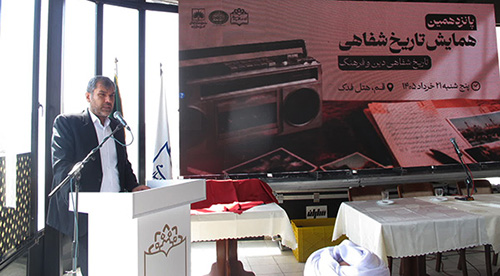
Then Hojjatoleslam Mohammad Hossein Foroughi, executive secretary of the 15th Iranian Oral History Conference and head of the Qom Islamic Revolution Documents Center, said about the neglect of oral history: “In Iran, we see a lot of neglect of oral history, and this issue is much more noticeable in religious cities. This issue goes back to the neglect of history and the fact that many cultural guardians look at history like a hobby and a story. The view that history can be used to make decisions again does not exist. In fact, Qom is a city without a narrative; a city where many events happen, but only one aspect of it is seen. A set of religious or more concrete issues; the seminary and the shrine of Hazrat Masoumeh (PBUH) come to mind. While many events have occurred in the city that have remained unrecorded and unregistered. We have organizations in Qom that do not attach any importance to scientific and academic work. In the last 5 years, a good thing that has happened in Qom is that independent oral history collections and movements have been formed in Qom outside of official structures. One of the reasons why oral history in Qom has taken a better shape in recent years is the removal of fathers and guardians from the oral history movement. Oral history of independent art, oral history of independent carpets, oral history of independent communities, oral history of the bazaar. That is, caring people have come to the rescue; without totalitarian, guardian-like, and pretentious institutions. I can confidently say that Qom is one of the few cities that has formed a specialized circle of oral history for women. In large collections that work on oral history, it can be said that 2 to 3 percent have worked on women's oral history, and the rest is men's oral history. Another thing was the elimination of red lines of taste. That is, many ifs and buts have been removed for interviewing individuals. Sometimes, the red lines are so absurd that a large volume of these narratives have been lost. Third point; I dare say that no collection in Qom does oral history work unless it is somehow related to us, and the only reason is that we tried to be friends instead of competing. If we have an interview that we cannot continue, we share and complement it with other collections. A large part of the interviews in the archives of different collections are about the same subject. Whereas if these archives were put together, they would be publishable. The last point is the diversity that has occurred in the oral history of Qom. We only worked on the oral history of art in Qom for nearly 1,800 hours, which is about music, graphics, writing, cinema, theater, and painting. This diversity is a good thing. I say that Qom is a city without narratives, because of the implementation of tastes, people were left aside and we wondered why these narratives were not recorded. Now, apart from the oral history of the seminary and the clergy, the oral history of Najaf, the oral history of Qom carpets, the oral history of women, and some biographies are being performed. I ask the curatorial collections to come and expand this narrow circle of oral history from political issues to cultural issues. »
Better Explanation of Contemporary History with Oral History
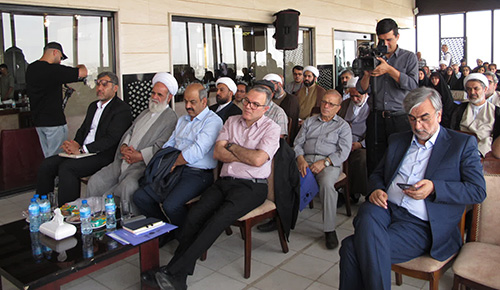
Following the 15th Iranian Oral History Conference, Dr. Gholamreza Amirkhani, head of the National Archives and Library Organization, referring to the organization’s 30-year history in the field of oral history recording, said: “So far, something over 770 to 780 oral histories have been conducted in the Archives Organization, of which perhaps about 90 titles have been published. The Revolutionary Archives Center has also achieved good things in the new era, and I was less aware of the work in Qom. Regarding oral history, what is commonplace is the issue of time and opportunities that are lost. Many of the works that we regret, I wish they had been done sooner, or for some, it was luck that the work was done and unfortunately the interviewee passed away after a while. One of the recent works conducted in the Archives Organization is the book Qessey-e Rastgoo (The Truthful Story); an oral history interview with Hojjatoleslam Mohammad Hassan Rastgou. He was healthy, but 20 days or a month after the last interview that Mr. Hadi Ghobadi, the head of the Documentation Center in the Qom branch, conducted, he died, and an oral history of him remained. On the other hand, the oral history of the late Mahmoud Hakimi that I conducted myself and unveiled in Qom. It did not take long before he also fell ill and passed away. This is an emphasis that these opportunities should be used.
Oral history, minus who he [the interviewee] was and what he did, can complete puzzles of our contemporary history. Perhaps some of the people involved and even ordinary people will ask what use is history after all? Now, history is definitely one of the most important obligations. In my opinion, our misfortune in the recent developments in the country is the discussion of history and history making. Due to our inaction, a contemporary history and an idealized atmosphere of the Pahlavi era were created, and our youth concluded that there was no escape; except for the return of Pahlavi, and this is also the loss we suffered. If we had acted a little more accurately to better express contemporary history, it would have been a good thing. Oral history can do an important part of it. This was a very important point, and government officials should realize this and emphasize it. While good work is being done, duplication should be avoided. Synergizing documentation centers and preventing parallel work is very important. Qom has a lot to do, and capturing the memories of those who have understood it since at least 1963 is important in contemporary oral history, and it can express a comprehensive history of the formation of the Islamic Revolution and the role of Qom and the clergy. So far, good work has been done, but the current work is both more standardized and uses oral history techniques. We at the Archives Research Center of the Archives Organization are also ready, based on our existing capabilities, to enhance and exchange experiences. Also, the bimonthly journal “Oral History” is published in this field.”
The vitality and spirit of history are with oral history
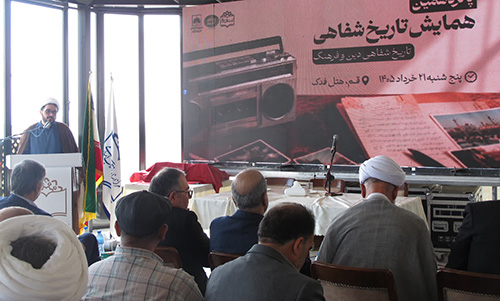
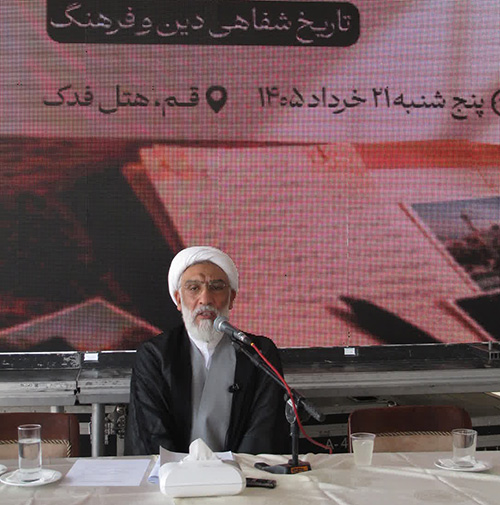
“Hojjatoleslam Mustafa Pourmohammadi,” the head of the Islamic Revolution Archives Center, also called history the environment of human life and stated, “If we are to say, who is a human being, what does he do, and where did he come from? We only have history. Historiography and historiography; that is, pointing out, presenting, and narrating the life of a human being, as the most prominent divine creation! In this regard, history has a high position. A society without history is a society without life, without identity, without an identity card, without a background, perspective, and path. Despite some shortcomings such as: memory errors, concealment, being influenced by subsequent events in analyzing the background, speaking selectively, showing off in expressing history, highlighting or minimizing in narratives, self-censorship of the narrator and the creation of atmospheres and framing of interviewers and the type of questions asked, today, the majority opinion of researchers and experts in the field of history is that they consider oral history to be the strength of today's historiography. Because the expression and narration of history is somewhat closed and perhaps frozen. However, the liveliness and spirit of history are with oral history. Because the historian collects documents and reports. However, the narrator tells his own life. He brings history to life and gives history soul and life. For this reason, oral history has played a role today and has allocated a significant part to itself in the fields of historical research and in global arenas. One side of history is historians who collect documents and analyze reports. The second side is oral history in its broadest form, and the third side is the complement of current narrative history and the history of documents that enriches it. Now, things are being said about history that are much better and richer than those written by historians of their time are. Because documents are attached. These bring the movement of history to life and as a result, we see a clearer picture of history.
I feel that the year 1404 is the boiling point and maturity of culture and religion. Religion has its place, but religion has been placed alongside a prominent Iranian culture. From March 9 to today, whatever we want to say about the history of culture and religion, it exists and decisive difficulties are seen.
After the 12-day war, I told my friends to try to record the memories of the victims and martyrs of this war. We have 1,300 martyrs during the 12-day war. We planned to publish the memorial of the martyrs of the 12-Day War in June 2026, when the Ramadan War began and our activities practically stopped. However, by that date, we had conducted 850 interviews and more than 1,800 hours of interviews with the families of the martyrs. We mobilized several teams to record this oral history on the scene and with the emotions, they had. Some families were unwilling to cooperate due to their mental conditions, but fortunately, many accepted. These are important aspects of history and are of great importance. The Ramadan War, which we are still struggling with, oral history, will be one of the effective and decisive tools in recording it.
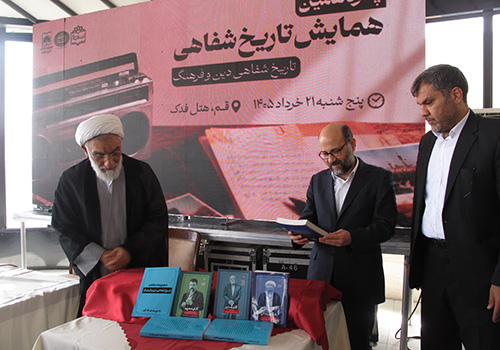
At the end of the first part of the 15th Oral History Conference, the book of the conference's collection of articles and the books Agha Moallem (Mister Teacher); Drama and Music narrated by Professor Hossein Norouzian, interviewed and edited by Ali Mohammadi, Mashq-e Zendegi (Exercising Life); Poetry and Writing narrated by Hojjatoleslam Javad Mohaddesi with the help of Mohammad Hossein Foroughi and Agha Modir (The Schoolmaster); Oral History of Seyyed Abbas Esmaeili Taba, edited by Fatemeh Sadat Hosseini and Mohammad Hossein Foroughi, were unveiled.
To be continued…
Number of Visits: 661
http://oral-history.ir/?page=post&id=13337