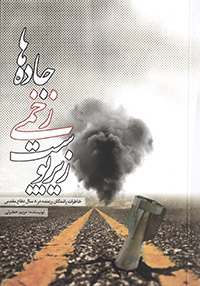
A trip “Under the Wounded Skin of Roads”
Memoirs of 50 drivers
Elham Saleh
Translated by Natalie Haghverdian
2016-6-6
There was a group usually ignored and less attended to during the war. Gradually, they as well, became an interesting subject for authors in an effort to introduce their hard work and endeavor to the public. “Under the Wounded Skin of Roads” has targeted this group: drivers, who during eight years of Holy Defense, drove in dangerous roads, who count their stories in this book.
“Under the Wounded Skin of Roads” is the story of 50 drivers, who, during Iraq imposed war against Iran, drove in fronts, operation sites and battlefields.
The book starts with an introduction and then narrates the memoirs of the drivers. Some memories are painful just like the one of Ali Niknam; a veteran exposed to chemical attacks who has suffered injuries in his eyes, lungs, skin, groin and sole: “I couldn’t see clearly. Through the black curtain hanging in front of me I saw a soldier from Mashhad. He had long beard and a big belly. During bomb attacks he had screamed and his mouth was full of quivers which had then penetrated his face and got out and he was martyred as he sat there.”
Some memories are normal such as the memory of Sattar Rezapour: “One night, I wanted to sleep in my car and I had just closed my eyes when I heard munching. I got up and jumped out of the car. There was no one there. Again I lay down and closed my eyes and again I heard munching. When I looked closely, I saw a rat which had found a biscuit under the car and was busy eating it. I threw all the biscuits out of the car and while it was busy munching them I fell asleep.”
There is a biography of the driver at the beginning of each story. Some memories are short and some are long.
“Under the Wounded Skin of Road” is a beautiful title and the image for the cover is also suitable; however, the content could have been drafted and processed to be more intriguing for the audience.
However, this book narrates the efforts of a specific group of people during the Holy Defense and each memory is part of the oral history of the war, recounted by the narrators, which is a concept that has rarely been addressed during these years.
Number of Visits: 5211



The latest
- Practical Models for Simulating Texts in Distinguished, Signature Styles, Under the Use of AI Tools in Resistance Literature
- A Recollection by Ali Tahiri of a Military maneuver
- 100 Questions/17
- Third Regiment: Memoirs of an Iraqi Prisoner of War Doctor – 17
- Oral History News of December-January 2026
- Analyzing the Impact of Sacred Defense Memories on the New Generation: Usage in Transmitting Values
- The Sha‘baniyya Uprising as Narrated by Ali Tahiri
- 100 Questions/16
Most visited
- Oral History News of December-January 2026
- Analyzing the Impact of Sacred Defense Memories on the New Generation: Usage in Transmitting Values
- Third Regiment: Memoirs of an Iraqi Prisoner of War Doctor – 16
- The Sha‘baniyya Uprising as Narrated by Ali Tahiri
- 100 Questions/16
- Third Regiment: Memoirs of an Iraqi Prisoner of War Doctor – 17
- 100 Questions/17
- A Recollection by Ali Tahiri of a Military maneuver
100 Questions/13
We asked several researchers and activists in the field of oral history to express their views on oral history questions. The names of each participant are listed at the beginning of their answers, and the text of all answers will be published on this portal by the end of the week. The goal of this project is to open new doors to an issue and promote scientific discussions in the field of oral history.Oral History of 40 Years
One of the main hypotheses regarding the reason for the growth and expansion of oral history in the modern era relates to the fact that oral history is the best tool for addressing lesser-known topics of contemporary history. Topics that, particularly because little information is available about them, have received less attention.Omissions in the Editing of Oral History
After the completion of interview sessions, the original recordings are archived, the interviews are transcribed, proofread, and re-listened to. If the material possesses the qualities required for publication in the form of an article or a book, the editing process must begin. In general, understanding a verbatim transcription of an interview is often not straightforward and requires editing so that it may be transformed into a fluent, well-documented text that is easy to comprehend.100 Questions/8
We asked several researchers and activists in the field of oral history to express their views on oral history questions. The names of each participant are listed at the beginning of their answers, and the text of all answers will be published on this portal by the end of the week. The goal of this project is to open new doors to an issue and promote scientific discussions in the field of oral history.