
A Pilgrim's Narrative of Post-War Mashhad
Faezeh Sassanikhah
Machine translation edited by Mandana Karimi
2026-7-6
The first thing that caught my eye in the courtyard of one of the Imam Reza (peace be upon him) shrines was a man sitting on one of the carpets, reciting a prayer, leaning the Iranian flagpole on his shoulder. Until I reached the Goharshad Mosque, I saw men and women carrying beautiful flags of Iran and Lebanese Hezbollah in large and small sizes; some of them were decorated with pictures of the martyred leader and the new leader. The pilgrims who went from one courtyard to another with the flags mixed epics, prayers, invocations, intercession, and pilgrimage.
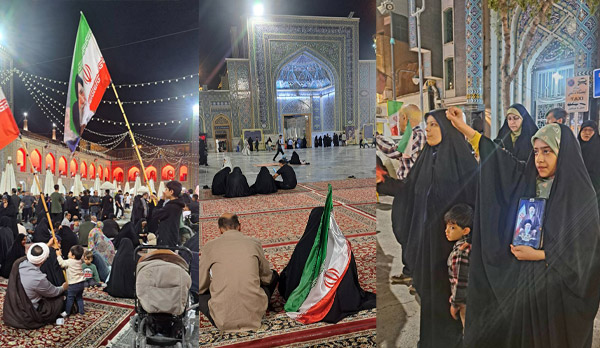
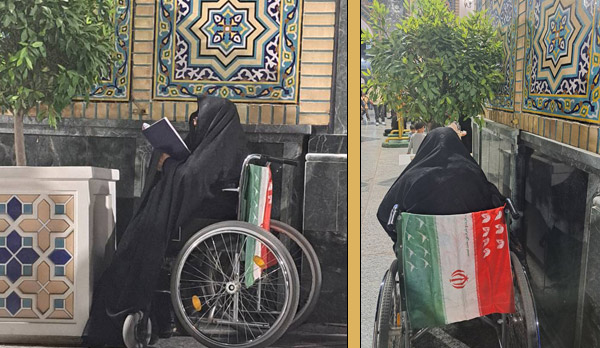
The flags had given a different clarity to the heavenly atmosphere of the courtyards and porches, and like veins of identity, they were present everywhere: on the shoulder of a young man holding his child, behind an elderly lady in a wheelchair, in the small hands of children, and on the shoulders of men and women, young and old! On the threshold of entering the shrine, from the Sheikh Tusi Gate, every day I saw boys in military uniforms who, next to the flags of Iran and Iraq, humbly waxed the shoes of pilgrims with prayers and with the intention of the manifestation of the Holy Hidden Imam.
But this feeling and mood had gone beyond the boundaries of the shrine. On the streets of the city, from the most distant streets to the paths leading to the shrine, photos of the martyred leader and the new leader were posted on the windows of shops. The variety of businesses and the large number of these shops were striking. From mobile phone shops to repair shops, restaurants, bookstores, and supermarkets. This resistance was not limited to shop windows and came to life at night in another way, in passionate street gatherings in squares and alleys. The people of Mashhad, despite not having heard the terrifying sound of mortars and the roar of American warplanes, and having never seen smoke, fire, or the collapse of buildings, were still in the squares after the ceasefire, like the people of the cities involved in the war. They stood on both sides of the streets and on the sidewalks, singing epic songs and chanting slogans.
Among these gatherings, the presence of Iraqi pilgrims also had a different appearance. They would appear in the squares, waving the flags of Iran, Iraq, and Quwwāt al-Ḥashd ash-Shaʿbī (the Popular Mobilization Forces), or driving around the streets in cars, watching the public gathering with delight.
The most beautiful scene for me was the presence of an Iraqi man wearing a dashka in Imam Hussein (peace be upon him) Square. He stood at a distance from the crowd, waving the Iranian flag. As if to say that his heart, body, and soul were with us in this war.
For me, who had come from a war city, this presence and support of the people, even during the silence of the battlefield, was a “strength of the heart.” Perhaps in their own opinion, this was simply doing their duty to the homeland. But for me, this was witnessing the true meaning of resistance.
I left Mashhad, with my heart still close to Bab al-Jawad, among the elegant gatherings near the shrine and the Mullah Haidar Mosque. Where the sound of epic slogans is so loud that its echo reaches the shrine and the main owner of the mourning for the martyrdom of our martyred leader.
Number of Visits: 8



The latest
- A Pilgrim's Narrative of Post-War Mashhad
- The Third Regiment: Memoirs of an Iraqi Prisoner of War Doctor - 37
- 374th Night of Remembrance - 1
- 100 Questions / 36
- The Underground City of Tehran
- Report of the 15th Oral History Conference; Religion and Culture -2
- The Third Regiment: Memoirs of an Iraqi Prisoner of War Doctor - 36
- Third Theory: Covering up the gaps in the document with oral narration
Most visited
- Report of the 15th Oral History Conference; Religion and Culture -1
- The Underground City of Tehran
- Javad Poyanfar's Memories
- Third Theory: Covering up the gaps in the document with oral narration
- Report of the 15th Oral History Conference; Religion and Culture -2
- 100 Questions/35
- The Third Regiment: Memoirs of an Iraqi Prisoner of War Doctor - 36
- 100 Questions / 36
Validation: Challenges and Necessities
Where does truth stand in oral history? How can the correctness of a narrative be recognized? Does fact-checking matter? If there is exaggeration in the reporting of some accounts, how can it be detected? Is it possible to record an event accurately through the recording of a narrative? Readers and users of oral history works are often faced with these questions, and sometimes encounter doubts about some oral history works.From Revolutionary Circles to the Military Arm of the Islamic Government
In those days, it became clear that certain institutions had to be established very quickly—institutions suited to the temperament, expectations, and lingering aspirations of the younger generation; young people who had been politically active before the Revolution and, in some cases, had been directly entangled in arrests, imprisonment, ...Authenticating Oral History: From Possibility to Necessity
The use of oral history as one of the historical sources has long been one of the principal challenges facing oral historians and those who employ it in contemporary historiography. The development of international standards for oral history, as well as IRIB standards, was intended to address the criticisms raised in this regard. The relationship between Diplomatics in written records and oral history is reciprocal.100 Questions/27
What is the place of research ethics in compiling oral history?We asked several researchers and activists in the field of oral history to express their views on oral history questions. The names of each participant are listed at the beginning of their answers, and the text of all answers will be published on this portal by the end of the week.

