Ramadan War
An Interview with Members of an Iraqi Mawkib Present at the Gatherings in Tehran
Interviewed and compiled by Faezeh sassanikhah
Translated by Kianoush Borzouei
2026-4-30
In early Farvardin (late March), while moving between the nightly gatherings in Khaghani Square, a booth set up on the corner of the square caught my attention. It was adorned with photographs of the martyrs of the Resistance Front, Ayatollah Sistani, and numerous flags. The Arabic music, the distribution of food and tea, and the volunteers greeting Iranians in Arabic with “Welcome” all evoked the atmosphere of Arbaeen. Their presence amid the country’s wartime conditions struck me as both pleasant and peculiar. In order to better understand their motivation for coming to Iran, I was able to interview two members of the booth.
***
Please introduce the Ansar al-Imam mawkib.
Abu Ali: The members of the booth live in different cities across Iraq, but its main base is in Baghdad. Beyond its activities in Iraq, the Ansar al-Imam mawkib has also been active in Yemen, Lebanon, and even Gaza, under the banner of Shiite resistance. Although it is an Iraqi booth, wherever it sees that fellow adherents are in need, it is there. Since the martyrdom of Sayyed Hassan Nasrallah in Lebanon, it has established a booth there and has been operating ever since, currently cooking and distributing 15,000 meals a day. With the beginning of war in Iran, we came from Baghdad at the beginning of the New Year to serve the noble people of Iran.
What was your purpose in coming to Iran?
Abu Ali: First, we came because of our faith and belief, especially our conviction in wellayah. We mujahideen seek martyrdom. For us, Iraq, Iran, Yemen, and Lebanon are one; there are no borders between us. We do not say, “We are Iraqis” no! We say we all follow one religion and one school of thought; our goal is one, and that is the downfall of the enemy. Second, in 2014 we were drawn into war with ISIS. The Iraqi government asked countries such as Russia, China, and the United States for assistance, but they did not help us. The United States promised aid months later. We bought our own weapons and ammunition at our own expense and fought with them. But when the Iraqi government requested help from Iran, Martyr Hajj Qassem Soleimani, acting on the order of Martyr Sayyed Ali Khamenei (may God have mercy on him), came to our aid with weapons in less than a day. For that reason, we could not ignore the kindness Iran showed us at that time. What we are doing now, and our service to the Shiites of Iran, is but a drop in the ocean of generosity that the Iranians have shown us. Our primary objective in coming to Iran was to bring some comfort to the people of Iran amid this crisis, which, God willing, will soon pass. When distributing food, our guys repeat the same phrases said to pilgrims during Arbaeen— for example, “Welcome, Shiite of Ali,” or “Welcome, Shiite of Haydar al-Karrar.” When people see that we stand in the square just as they do, they are happy. When I see that our presence, sympathy, and spiritual support bring joy to my brothers in faith and in sect, I feel deeply gratified.
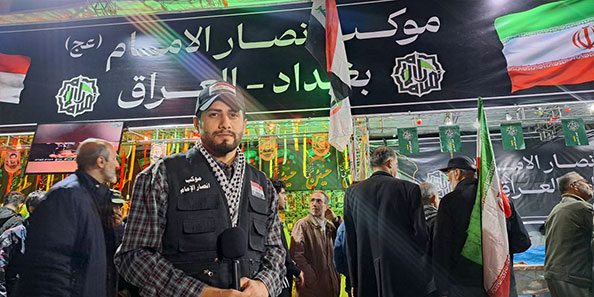
Bager Jaberi
Bager Jaberi: We came to serve the people of Iran. Iran is a country that sacrifices itself for its creed and its sect. During the period in 2014 when ISIS attacked Iraq and until the end of the war, the government and people of Iran stood with us. They even offered martyrs in this path. This is a debt upon our shoulders, and we must repay it, even if only in a modest way. Of course, we know that we cannot truly repay it; until now, we have only been servants. God willing, we intend to remain in Iran and serve the people, and we are ready to offer whatever lies within our capacity. This is merely a small part of our activities as Iraqis. The people of Iraq are collecting gifts for Iran to the extent of their means and sending them. We are at a stage where even Iraqi girls are donating their gold earrings to the people of Iran.
How have you found the spirit and morale of the Iranian people during this period?
Abu Ali: It has been excellent. At night we are busy distributing food and refreshments to the people. At the end of the night, once our work is done, we attend the public gatherings in the square. God is my witness, we are moved to tears by the sight of these people. When we see the old and the young, veiled and unveiled women, the religious and the non-religious, all supporting their country, we are profoundly affected. I used to think that only religious people supported Iran; now I see that all segments and professions are standing by their country. When I see them, my fatigue disappears. I do not feel far from my family. I truly feel at ease. The conduct of the Iranian people gives me a particular serenity—a feeling that cannot be put into words.
Baqer Jaberi: The morale of the people is very good. They behave quite normally, in a natural and unforced way. The city is secure and calm. Before coming, I did not imagine it would be like this. That is why I film the nightly gatherings and the everyday lives of the people, interview them, and send the footage to Iraq so that my countrymen can see what is happening in Iran.
Have you witnessed any particular scene at these gatherings that especially caught your attention?
Abu Ali: Yes, many. We have hung photographs of the martyrs of Ansar Allah in Yemen, Hezbollah in Lebanon, and the martyrs of Iraq and Iran in our booth. Once, a woman came and looked at the photos of the martyrs, and although she did not know who they were, she was crying. Or take the turbah of Imam Hussein that we brought with us: when we give this sacred soil to people of different ages, it transforms their mood and brings tears to their eyes.
Baqer Jaberi: What has most caught my attention is the presence of families in these gatherings — especially children sitting in strollers with flags in their hands. Or when elderly men and women come using canes or wheelchairs; that is very striking to me. In my view, this square is a sacred place.
Before traveling, did you have such an image of the situation in Iran?
Abu Ali: No. We thought the conditions would be more severe, because a camera shows only ten percent of the truth. The rest must be seen for yourself. Here, although there are attacks or bombings every day—or their sounds can be heard—the people remain in the square; men and women are passing through the streets by car, motorcycle, or on foot, and life continues as normal.
Baqer Jaberi: This is my first time in Iran. Before the war, I had heard that Iran was beautiful and orderly, but after the war we were told that Iran had turned into ruins. When I came here and saw this calm and the strong spirit of the Iranians, I was shocked. When people in Iraq, especially Iraqi students studying in Iran, ask me about the situation here, I tell them that the country is safe.
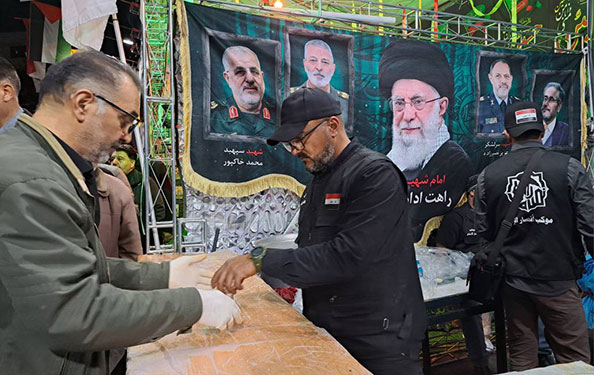
The 2nd Person from right: Abu ALi
How did you feel when you heard the news of the martyrdom of Grand Ayatollah Sayyed Ali Khamenei?
Abu Ali: (weeping intensely) I cannot say it.
Baqer Jaberi: We thought that Sayyed Ali himself would eliminate America and Israel and that we would pray in Palestine. But when we heard the news of his martyrdom, we were all astonished and shocked. Our homes turned into mourning houses; my father, mother, wife, and even our children were in mourning. On the day the news of the martyrdom of the “Martyred Sayyed” was announced, all the shrines in Iraq extinguished their lights for the morning prayer, cried “Allahu Akbar,” and that same day went into the streets in mourning. In general, the people of Iraq had a special affection for the “Martyred Sayyed.”
Did you think that after the martyrdom of Iran’s leader, the Islamic Republic would remain in place?
Abu Ali: Everyone thought that if [Ayatollah] Sayyed Ali Khamenei were martyred, the Iranian system would collapse. They believed that America was a superpower and could bring about a change of power in Iran within two days. Yet the whole world saw that the equation was reversed; the people of Iran are supporting the Islamic Republic and their government more firmly than before. I pray that, God willing, the people of Iran will always remain victorious and safe under the shadow of the Ahl al-Bayt. As long as we pay heed to the Ahl al-Bayt, they will not forget us either. God willing, may you always be victorious.
Baqer Jaberi: The martyrdom of a leader does not mean the end of a country; rather, just as blood triumphed over the sword in the event of Karbala, so too will this martyrdom cause blood to prevail over the sword.
I believed that Ayatollah Sayyed Ali had already prepared everything before his martyrdom; I was waiting for the next leader to be chosen. God willing, may Iran always remain secure. May God protect the new leader, the government, and the people. We are ready to sacrifice our blood, our lives, and our wealth for Iran. Sunni sheikhs used to say that before the revolution of Ayatollah Khomeini, whenever they asked Shiites, “Are you Shiite or Muslim?”, they would answer, “Muslim.” But after the revolution of Ayatollah Khomeini, they proudly said, “Yes, I am Shiite.” In my view, this is one of the blessings of Imam Khomeini’s revolution, which restored our dignity.
Related Articles:
The Ramadan War: A battle of Wills
The Beating Pulse of a Nation at the Moment of Nowruz
Number of Visits: 1020
Share


The latest
- Seventh Theory: The evolutionary duality of document and narrative
- Memories of Davoud Molaei
- Preparing a report for Khorasan Radio and Television
- 100 Questions/47
- The Third Regiment: Memoirs of an Iraqi Prisoner of War - 47
- Servants Narration of the Religious Rituals of the Holy Shrine of Imam Reza (AS) From Tradition to Lived Experience
- Memories of Nasrollah Fat’hian
- Memories of Hossein Ali Najafian
Most visited
- The Third Regiment: Memoirs of an Iraqi Prisoner of War - 46
- 100 Questions/46
- Servants Narration of the Religious Rituals of the Holy Shrine of Imam Reza (AS) From Tradition to Lived Experience
- Memories of Hossein Ali Najafian
- Memories of Nasrollah Fat’hian
- The Third Regiment: Memoirs of an Iraqi Prisoner of War - 47
- 100 Questions/47
- Preparing a report for Khorasan Radio and Television
100 Questions / 43
How can narrators and interviewers reach a common understanding?We asked several researchers and activists in the field of oral history to express their views on oral history questions. The names of each participant are listed at the beginning of their answers, and the text of all answers will be published on this portal by the end of the week.
Documentary Pathology of the US Embassy Documents
The Necessity of Scientific Rereading and Content Analysis of DocumentsMore than four decades have passed since the publication of the first collections of documents from the US Embassy in Tehran. However, despite the relatively easy access to this treasure trove of documents, systematic research exploitation of it has not been adequate. We still do not have a “comprehensive picture” of the content of these 11,000 documents.
100 Questions / 42
What is the importance of the narrator and interviewers shared understanding of the past in oral history?We asked several researchers and activists in the field of oral history to express their views on oral history questions. The names of each participant are listed at the beginning of their answers, and the text of all the answers will be published on this portal by the end of the week.
Validation: Challenges and Necessities
Where does truth stand in oral history? How can the correctness of a narrative be recognized? Does fact-checking matter? If there is exaggeration in the reporting of some accounts, how can it be detected? Is it possible to record an event accurately through the recording of a narrative? Readers and users of oral history works are often faced with these questions, and sometimes encounter doubts about some oral history works.