
Mandela changed S. Africas geopolitical map
2011
Translator of Conversations with Myself said that the book holds the first South African president, Nelson Mandelas memories and biography and added: The book is a pictorial supplement the world enjoys of Mandela which indicates the character and life of a man who altered South Africas geopolitical map all by himself.
IBNA: Ali Akbar Abdul-rashidi said that the book will be marketed by the next month and I changed its Persian title for the Iranian readers.
Mandelas ýLong walk to freedom: the autobiography of Nelson Mandela was rendered into Persian as well. In the book, Nelson Rolihlahla Mandela (born 18 July 1918) recounts his memories of his activities and political campaigns till his freedom from the prison. Conversations with Myself has been released by a foundation named after Mandela in South Africa but of course with new information, he added.
Talking about the new points of Conversations with Myself, the translator added: Besides the data of ýLong walk to freedom: the autobiography of Nelson Mandela, the other book holds documents, manuscripts and South Africas data of a racist government period in which Mandela lived. A collection of his interrogations and defenses in jail, the police report about him and his family and his presidency.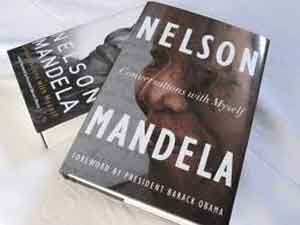
He said that the book is somehow a review of Mandelas memories and life according to documents as well as others and his own statements. A part of the book is about the political figures trip during his presidency as well as his notes and his daily writings during his imprisonment.
Moreover he added that Africas political leader was a disciplined figure who jotted down all his daily programs including his medicines or even phone calls. Many of the letters Mandela wrote for his family or friends or the letters others sent for him were delivered with censorship or sometimes they even disappeared. The book holds all the letters as well.
The book is a pictorial supplement the world enjoys of Mandela he said and added: The books foreword is authored by Barack Obama.
Talking about Mandela and his impressing points of view he added: Certainly he is a hero of contemporary history, although with his own specific culture and the features which exist in South Africas Anti-racism campaigns. So the book depicts a man who spent 27 years of his life in prisons and mostly solitary confinements but never shunned his ideal of establishing equality particularly for the black Africans.
The book presents Mandelas character as well as his opinions, companionships as well as the opposition of many of his friends and fellows.
Number of Visits: 5822



The latest
- Ta An Setareh (Up to that Star) (Part One)
- Memoirs of Mohammad Kazem Taqavi
- Theory Two: The Borderline Legitimacy Crisis of Oral History in the Academic System
- 100 Questions/ 31
- Third Regiment: Memoirs of an Iraqi Prisoner of War Doctor – 31
- 100 Questions/ 30
- The Story of a Street Classroom
- Validation: Challenges and Necessities
Most visited
- Memories of Mr. Jalal Setareh
- Third Regiment: Memoirs of an Iraqi Prisoner of War Doctor – 30
- Validation: Challenges and Necessities
- The Story of a Street Classroom
- 100 Questions/ 30
- Third Regiment: Memoirs of an Iraqi Prisoner of War Doctor – 31
- 100 Questions/ 31
- Theory Two: The Borderline Legitimacy Crisis of Oral History in the Academic System
Authenticating Oral History: From Possibility to Necessity
The use of oral history as one of the historical sources has long been one of the principal challenges facing oral historians and those who employ it in contemporary historiography. The development of international standards for oral history, as well as IRIB standards, was intended to address the criticisms raised in this regard. The relationship between Diplomatics in written records and oral history is reciprocal.100 Questions/27
What is the place of research ethics in compiling oral history?We asked several researchers and activists in the field of oral history to express their views on oral history questions. The names of each participant are listed at the beginning of their answers, and the text of all answers will be published on this portal by the end of the week.
Photo Album from The Doctor of fly
The Doctor of fly, authored by Fatemeh Dehghan Niri, presents the memoirs of Dr. Mohammad-Taqi Khorsandi Ashtiani, Professor Emeritus and a subspecialist in Otolaryngology at Tehran University of Medical Sciences. Compiled within the framework of oral history, the work recounts different stages of his life—from childhood and years of ...The Beating Pulse of a Nation at the Moment of Nowruz
Every year, in the days and nights leading up to Nowruz, Shohada Square had a special charm. A few days before the New Year, the shops would fill with customers, and street vendors would take over the sidewalks. You could find everything in their stalls (from items for the Haft Sin table, candles, goldfish, and spring flowers to clothes, bags, and shoes).
